 As ashamed as I am to say it, this oral history, Voices from the Storm, is something I'd usually never pick up at a bookstore, and the only reason I got it was because it was on sale for $5.00 at Timothy McSweeney's garage sale. Once I received my copy, however, the stories absorbed me within the first ten pages. The meticulously edited interviews with fourteen survivors of Hurricane Katrina--young, old, single, mothers of nine, black, Arab-American, American Indian, white--were compelling not just for the stories they were telling but also the way in which those interviewed spoke. Many of the interviewees' very poor education hadn't even equipped them with the vocabulary to describe the atrocities they witnessed. The surprising variety of their stories amazed me also: one man, after weeks of rescuing neighbors and strangers, was arrested and held in jail without bond or a phone call under suspicions (unfounded and racist) of terrorism. (For more on this man Abdulrahman Zeitoun, explore Dave Eggers' recent work of nonfiction, Zeitoun.) Many families were stuck in New Orleans' infamous housing projects; one man was wrongfully imprisoned for a traffic violation the night before the storm hit and was trapped inside his cell when guards abandoned the prisoners. Each story is affecting in its own way, and definitely allowed me to better understand the magnitude of the suffering Katrina--and, to a large extent, the U.S. government--inflicted upon hte residents of New Orleans.
Saturday, August 22, 2009
Voices from the Storm: The People of New Orleans on Hurricane Katrina and Its Aftermath
As ashamed as I am to say it, this oral history, Voices from the Storm, is something I'd usually never pick up at a bookstore, and the only reason I got it was because it was on sale for $5.00 at Timothy McSweeney's garage sale. Once I received my copy, however, the stories absorbed me within the first ten pages. The meticulously edited interviews with fourteen survivors of Hurricane Katrina--young, old, single, mothers of nine, black, Arab-American, American Indian, white--were compelling not just for the stories they were telling but also the way in which those interviewed spoke. Many of the interviewees' very poor education hadn't even equipped them with the vocabulary to describe the atrocities they witnessed. The surprising variety of their stories amazed me also: one man, after weeks of rescuing neighbors and strangers, was arrested and held in jail without bond or a phone call under suspicions (unfounded and racist) of terrorism. (For more on this man Abdulrahman Zeitoun, explore Dave Eggers' recent work of nonfiction, Zeitoun.) Many families were stuck in New Orleans' infamous housing projects; one man was wrongfully imprisoned for a traffic violation the night before the storm hit and was trapped inside his cell when guards abandoned the prisoners. Each story is affecting in its own way, and definitely allowed me to better understand the magnitude of the suffering Katrina--and, to a large extent, the U.S. government--inflicted upon hte residents of New Orleans.

Thursday, August 13, 2009
Maps and Legends: Reading and Writing Along the Borderlands, Michael Chabon
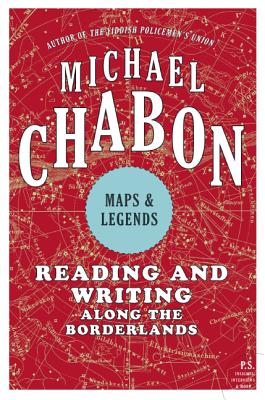 My dad gave me Maps and Legends because he'd read The Amazing Adventures of Kavalier & Clay (an essential for next summer's reading list) and loved Michael Chabon's prose style. I did too--at first his unbelieveably long sentences and the occasional archaic word threw me, but I soon adapted and grew to admire the individuality of his writing. Maps and Legends is a collection of essays--Chabon's first--and one worth reading. The collective theme of the book lies in its subtitle; Michael Chabon is writing in defense of borderlands from literary to ethnic, on which he writes remarkably well, considering his passion for both genre literature and his Jewish heritage. The collection inspired me to add Chabon's first novel, The Mysteries of Pittsburgh, to both The List and the hold shelf at the library; I hope to continue my foray into Michael Chabon's writing.
Monday, August 3, 2009
The Immoralist, Andre Gide
I picked up The Immoralist a few years ago at the Brown Elephant and have been looking forward to reading it for a while. It was published in France in 1902, and was extremely controversial for what the back of my Penguin classic edition deems its "frank defense of homosexuality." A short novel, The Immoralist is narrated by its protagonist in the form of a monologue to the narrator's friends. I expected it to be much more thrilling that it turned out to be, but I suppose that is the fault of the time at which it was published. Still, it didn't engage me; it felt dry and monotonous. I should have known that if Gide published it and went on to win the Nobel Prize in 1947, it wasn't going to be any Queer as Folk. One can always hope...

Indie bookstore #3
Bookworks
3444 N. Clark
Chicago, IL
(773) 871-5318
In pursuit of my books for classes next month, I've been searching used bookstores near and far and went into the heart of Wrigleyville this past weekend to a recent favorite of mine: Bookworks. Not atypical of an urban used bookstore, Bookworks is cramped--and crammed--but they have a wonderful selection and a helpful and friendly staff. They buy used books, sell CDs, are open late, and are in a great, stimulating location in the Lakeview neighborhood. (If you're looking for a snack, head a block south on Clark to Pick Me Up, my favorite all-night cafe and diner.) I wasn't able to find the rare-ass books my professors have assigned, but I enjoyed a rainy Saturday morning much more than I would have at home.
3444 N. Clark
Chicago, IL
(773) 871-5318
In pursuit of my books for classes next month, I've been searching used bookstores near and far and went into the heart of Wrigleyville this past weekend to a recent favorite of mine: Bookworks. Not atypical of an urban used bookstore, Bookworks is cramped--and crammed--but they have a wonderful selection and a helpful and friendly staff. They buy used books, sell CDs, are open late, and are in a great, stimulating location in the Lakeview neighborhood. (If you're looking for a snack, head a block south on Clark to Pick Me Up, my favorite all-night cafe and diner.) I wasn't able to find the rare-ass books my professors have assigned, but I enjoyed a rainy Saturday morning much more than I would have at home.
Sunday, July 26, 2009
Newberry Library Book Fair
I went yesterday and can barely bear to speak of it. It was the first day I was available to go, and the fair runs from Thursday to Sunday (with a preview night for rich people on Wednesday night)... I can't go on: I didn't find a single book.
Native Son, Richard Wright

"Native Son" was, by far, the best book I've read this summer. It is a masterpiece of American drama that, tragically, I found as much application to contemporary Chicago (and the rest of the United States) as I would have found in the decade of its authorship, the 1940s. I connected deeply with Bigger Thomas' oppression and the oppression of Blacks and Communists in the era "Native Son" took place, in part because of the parallel oppression gay Americans face today. Among other things, this novel is a critique of blame and the notion of collective guilt, and the way different racial, ethnic, and political groups view one another.
I never thought I'd find myself including what is essentially a political novel (Richard Wright was a staunch member of the Communist party in Chicago, and the book's themes and characters surely reflect that fact) among one of my favorite books. However, since finishing "Native Son" nearly two weeks ago, Bigger has not left my mind. His story tapped into a quiet anger I didn't know I had, infused me with deep guilt at having implicitly taken part in the oppression of others, gave me a better understanding of Black America today, and allowed me to compare experiences of oppression across communities.
I can't do the best job I'd like at describing how thought-provoking and startling "Native Son" was for me, but I hope that it is included more often on required reading lists--not just for African-American-focused courses or political science courses, but for American literature and history as well.
I never thought I'd find myself including what is essentially a political novel (Richard Wright was a staunch member of the Communist party in Chicago, and the book's themes and characters surely reflect that fact) among one of my favorite books. However, since finishing "Native Son" nearly two weeks ago, Bigger has not left my mind. His story tapped into a quiet anger I didn't know I had, infused me with deep guilt at having implicitly taken part in the oppression of others, gave me a better understanding of Black America today, and allowed me to compare experiences of oppression across communities.
I can't do the best job I'd like at describing how thought-provoking and startling "Native Son" was for me, but I hope that it is included more often on required reading lists--not just for African-American-focused courses or political science courses, but for American literature and history as well.
Sunday, July 19, 2009
A Natural History of the Senses, Diane Ackerman
Many know Diane Ackerman for her most recent novel, The Zookeeper's Wife. While I haven't read the latter, A Natural History of the Senses urged me to investigate. My second nonfiction selection of the summer, Ackerman's book lives up to the promise of its title--and more. Getting dry only near page 250 of its 300-plus pages, the rhythm picks up shortly thereafter, leaving the reader with a sense of accomplishment at having absorbed so many interesting tidbits of information on the five senses, and at having, in a sense (pun entirely intended), recharged: For after completing A Natural History of the Senses, I was made aware of the wonder of my functioning body for perhaps the first time. Since I'm not as aware of trends in recent nonfiction as I'd like to be, I can't be sure, but from what I've read in the Tribune and heard from friends, it would seem that Ackerman's book ranks with some of the best of those pop-science books (a la "Bonk," "Freakonomics," etc.) that have graced the bestseller lists in the last few decades. I'd definitely recommend A Natural History of the Senses to anyone looking to beef up on interesting party facts. (Why do you think I read it? Girls always chase after those witty intellectuals.)

- Orphaned calves are wrapped in the skins of stillborns so that the mother of the stillborn will nurse the orphan--if she can't smell that the calf is her own, she won't nurse it.
- Those with smell disorders also find their sex drives lowered and have problems with their long-term memory.
- Touch is ten times stronger than verbal or emotional contact.
- In medieval times, a knight wore a lock of his lady's pubic hair into battle.
- Women often have colder hands and feet than men because when temperatures lower, the body automatically sends blood to protect her reproductive organs from freezing.
- Potato chips were invented in Saratoga Springs in the late 1800s.
- Those who crave carbohydrates are attempting to raise their levels of serotonin, as do those who suffer from seasonal affective disorder; ingredients in most carbohydrates have been tested and results show them to increase personal contentment.
- Humans can talk for exactly the same reason they can choke so easily: their larynx lies lower in their throat than the larynx of any other mammal.
- One's perception of color can be effected by emotions and memories associated with the color.
These were just a few of the surprisingly interesting things Ackerman dug up to include in her book; if you find any of them as intriguing as I do, I'd suggest checking it out.
Subscribe to:
Posts (Atom)
